
Rapid fiber diagnostics and fault detection with intelligent Optical Link Analysis
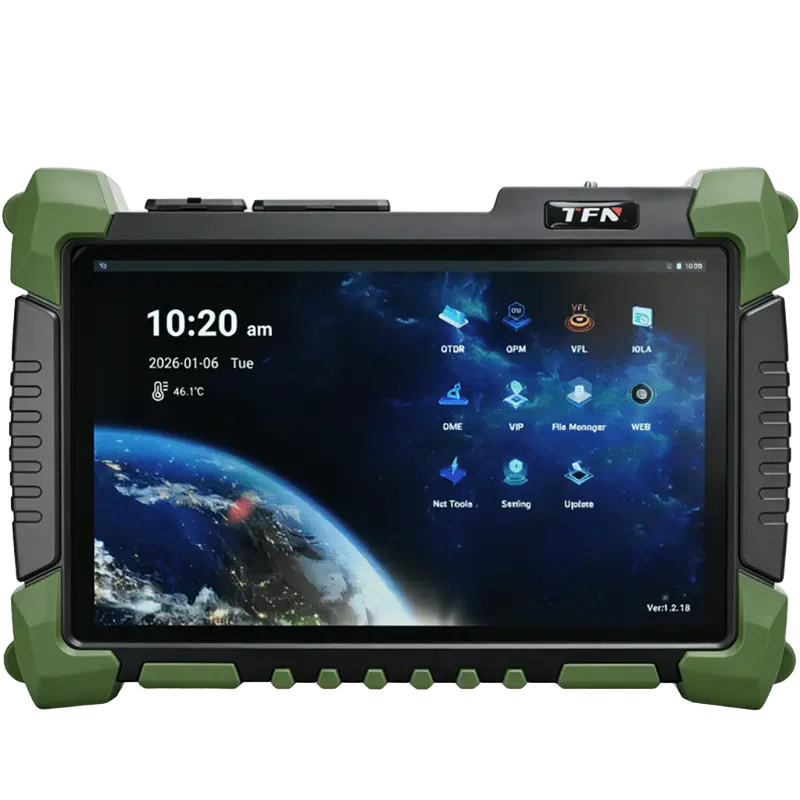
The RM7 OTDR series is designed for high-precision optical fiber testing across long-haul backbone links, tactical communication systems, FTTx/PON infrastructure, mobile command networks, and secure defense communication facilities. It helps field engineers rapidly locate faults, certify fiber links, and maintain operational readiness in demanding environments.
Description
Intelligent Optical Link Analysis (iOLA)
Traditional OTDR traces often require experienced technicians to interpret complex reflection curves and event signatures. The RM7 simplifies this process through Intelligent Optical Link Analysis (iOLA).
The system automatically performs multiple intelligent measurements and converts the results into an easy-to-read graphical link map. Connectors, fusion splices, splitters, bends, and reflective events are automatically identified and categorized.
This approach reduces interpretation errors and shortens troubleshooting time, especially in complex PON or distributed optical networks where splitter loss and overlapping reflections can complicate standard OTDR analysis.

High Dynamic Range for Long-Haul and Splitter Networks
With a maximum dynamic range of up to 50 dB, the RM7 supports testing across long-distance optical infrastructure and high-loss passive optical networks.
Military and defense communication systems frequently include:
- Long outdoor feeder fibers
- Multiple splice closures
- Passive splitters
- Temporary field connections
- Redundant backbone routes
These environments can generate significant attenuation and reflection challenges. The RM7 provides sufficient optical budget to identify faults beyond splitters and over extended distances, supporting both backbone and access-layer diagnostics.
Precise Near-End Fault Detection
The RM7 features an ultra-short 0.6 m event dead zone, enabling accurate identification of closely spaced events such as:
- Patch panel connections
- Dense rack interconnects
- Short jumper links
- Multiple connectors inside communication shelters
- Compact vehicle-mounted fiber systems
Short dead zone capability is critical when testing tactical communication racks or mobile command systems where multiple reflective events may occur within a very limited physical distance.
The system improves visibility of closely spaced connectors and splice points that may otherwise merge together in standard OTDR measurements.


Detachable Multi-Function Test Modules
Unlike conventional all-in-one testers, the RM7 allows the OPM, VFL, and Laser Distance Meter modules to be detached and used independently.
- OTDR testing can continue while another technician uses the OPM separately
- VFL can quickly identify patching errors without carrying the full OTDR
- Laser Distance Meter assists cable route surveying and deployment planning
The detachable structure reduces equipment load for rapid-response maintenance personnel and simplifies onsite workflow
Fast Data Connectivity
The RM7 supports:
- Cellular data transmission via SIM card
- USB data transfer
- Gigabit Ethernet
- Wi-Fi connectivity
- Bluetooth communication
Specification
| Model | Wavelength (nm) | Dynamic Range | Event Dead Zone | Attenuation Dead Zone |
| RM7-S3 | 1310/1550 | 42/40 dB | 0.6 m | 2.5 m |
| RM7-S4 | 1310/1550 | 45/43 dB | 0.6 m | 2.5 m |
| RM7-S5 | 1310/1550 | 50/48 dB | 0.6 m | 2.5 m |
| RM7-M1 | 850/1300 | 26/32 dB | 1 m | 4 m |
| RM7-SM1 | 850/1300/1310/1550 | 26/32/40/38 dB | 0.6 m | 2.5 m |
| RM7-C1 | 1310/1550/1625 | 44/42/40 dB | 0.6 m | 2.5 m |
| Parameter | Value |
| Distance Resolution | 0.05 m |
| Loss Resolution | 0.001 dB |
| Operating Temperature | -10°C to 50°C |
| Battery Life | 15 hours |
| Display | 10.1-in touchscreen |
| Dimensions | 287 x 190 x 74 mm |
RM7 DEMO
See the product in action — discover its key features and performance in seconds.

Applications

Tactical Fiber Deployment
Military field networks often use temporary or rapidly deployed fiber links between command vehicles, radar systems, and remote communication nodes. These links are vulnerable to connector contamination, cable bending, and physical damage during deployment.
The RM7 OTDR helps technicians quickly locate breaks, high-loss splices, and bending events. Its compact design and intelligent iOLA analysis simplify troubleshooting during time-sensitive field operations.

Military Base Communication Infrastructure
Military bases rely on fiber networks connecting command centers, surveillance systems, data facilities, and security infrastructure. Aging connectors, moisture intrusion, or poor splicing can cause signal degradation and intermittent communication issues.
With up to 50 dB dynamic range, the RM7 supports fast fault localization, backbone fiber maintenance, and optical link verification across large facilities.

Naval & Coastal Defense Networks
Fiber systems in naval bases and coastal defense sites are exposed to humidity, vibration, and salt-rich environments that can accelerate connector degradation and increase optical loss.
The RM7 helps maintenance teams identify deteriorating connectors, excessive attenuation, and reflection events before they affect critical communication systems.
Frequently Asked Questions
The RM7 combines high dynamic range, short dead zone performance, intelligent link analysis, and rugged portability in a single platform. These capabilities are important for troubleshooting tactical fiber systems, military communication backbones, and field-deployed optical networks.
Conventional OTDR traces can be difficult to interpret, especially in networks with splitters or multiple reflective events. The RM7 iOLA function automatically identifies connectors, splices, splitters, and bends using a graphical link map with pass/fail indicators, reducing troubleshooting time and minimizing interpretation errors.
A short event dead zone allows technicians to distinguish closely spaced connectors and events that commonly exist inside communication racks, shelters, and tactical systems. This improves troubleshooting accuracy in dense fiber environments.
Yes. Optional 1625 nm and 1650 nm wavelengths support testing on live optical networks using filtered maintenance wavelengths commonly applied in operational PON environments.
The RM7 can help detect:
- End-of-fiber events
- Fiber breaks
- High-loss splices
- Dirty or damaged connectors
- Macro-bends
- Reflective events
- Splitter-related loss
- Excessive attenuation
Yes. The RM7 supports standard SOR file export as well as PDF report generation for maintenance records, network certification, and project documentation.